Mont Kosciuszko is a climb of 16.0 kilometers (hors catégorie). Mont Kosciuszko tops out at 1,582 m above sea level. It is located in Snowy Valleys Council, New South Wales, Australia. The average gradient is 7.3% with a maximum of 17.3%. The climb has 1171 meters of elevation gain.
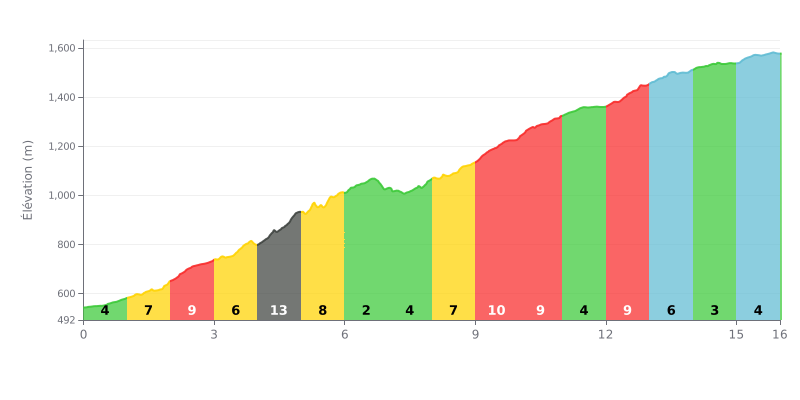
Climb analysis: At 16 km, this climb is hard because of its high average gradient (7.3%) and its 1171 m of elevation gain. The main difficulty lies in the very uneven gradients: a 14% kilometer (KM 4-5) and several stretches between 9% and 10%, broken up by easier sections at 2% (KM 6-7). This profile demands constant adjustment of your effort.
Tips for managing your effort:
1. Pace yourself on the critical kilometer: Prepare for the very steep 14% section (KM 4-5) by dialing back your pace from the start to avoid blowing up your legs and your heart rate.
2. Make the most of the recovery sections: Use the low-gradient sections (2-4%, like KM 6-7 and KM 14-15) to recover by spinning easily, without forcing, so you tackle the next sections fresher.
3. Keep a steady cadence: With the constant changes in gradient, aim for a steady cadence rather than a constant speed. Shift gears early to keep an efficient pedal stroke through the transitions.
From the accounts of cyclists who have climbed it, the ascent of Mount Kosciuszko is a unique experience, the chance to conquer the roof of Australia. The summit, at 2228 m elevation, gives a real sense of accomplishment and 360-degree panoramic views over the Australian Alps that more than reward the effort.
The most common approach for cyclists seems to be from Thredbo, with the option of taking the chairlift to skip the steepest climb. From there, the track to the summit is mostly described as wide, well maintained and relatively easy, with a gradual gradient rather than technical sections. However, some riders point out that the final section can be steeper and that the total distance (about 13 km return from the top of the chairlift) makes it an outing that requires a certain amount of endurance.
The most striking element for cyclists is the total exposure to the elements. Even in summer, the wind can be extremely strong and cold at the top, and the weather can change quickly. It is essential to come prepared with warm layers, a windproof jacket and sunscreen, because there is no shelter anywhere on the route. The presence of persistent snow patches, even early in the summer, is also mentioned.
The atmosphere is described as very touristy and busy, especially during the holidays. The track, partly made of metal boardwalks, makes access easy but can take away some of the wild adventure feel for some people. Cyclists encounter many hikers, and the summit can get crowded. One point to watch out for is the need to check the chairlift timetable carefully for the descent, otherwise the outing could end up being significantly longer.
16.0 km • 1171 m D+
VAM: average climbing speed, based on elevation gain


Join thousands of cycling fans! Plan your rides, record your performance, track your progress and discover the finest climbs.
Live climb profile to pace your effort all the way to the top.