Sierra Negra - Gran Telescopio is a climb of 42.3 kilometers (hors catégorie). Sierra Negra - Gran Telescopio tops out at 4,564 m above sea level. It is located in n/a, Veracruz, México. The average gradient is 8.4% with a maximum of 18.8%. The climb has 3563 meters of elevation gain.
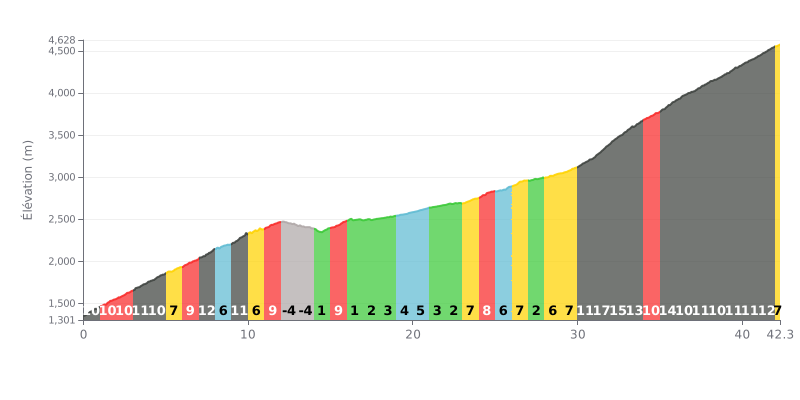
Difficulty analysis: This 42.3 km climb is extremely demanding, with 3,563m of total elevation gain. The difficulty lies in its length combined with severe gradients, notably a stretch of 17% and 15% between km 31 and 33, and a very steep finish (10-12%) over the last 7 km. The descents (KM 12-14) and false flats (KM 14-22) offer brief respite but don't make up for the overall effort.
Effort management tips:
1. Pacing: Start very conservatively to save your legs. The climb gets really hard after KM 30, so it's crucial to have energy in the tank.
2. Plan for the key sections: Use km 12 to 22, which are less steep, to recover actively (spin an easy gear, keep drinking) before the brutal run of high gradients.
3. Save something for the end: Keep a mental and physical buffer for the last 10 km, which have an average gradient above 10%.
Cyclists who have climbed the road to the Large Millimeter Telescope describe a demanding climb because of the altitude, which tops 4,000 meters. Riders' accounts mention the need for good fitness to tackle the gradient and the thin air, with some experiencing "altitude sickness." The reward, however, is worth the effort.
What makes this ride unique, according to the accounts, are the breathtaking views. At the summit, the view of Pico de Orizaba, Mexico's highest peak, is described as "impressive," "unforgettable," and "magical." Many riders rave about the beauty of a night ascent to catch a glorious sunrise from the top.
Access to the telescope itself is restricted. Accounts say it is often impossible to enter the facilities without a prior permit obtained from INAOE. Most cyclists settle for seeing the telescope from the outside, which for them is still a rewarding experience. It's crucial to check before setting off, as access can be closed, as it was during the pandemic.
Riders recommend good preparation: warm clothing is essential since temperatures can hover around 0°C, and the weather can change fast with fog rolling in. Bring water, food and sugary snacks to keep your energy up during the effort.
42.3 km • 3563 m D+
VAM: average climbing speed, based on elevation gain


Join thousands of cycling fans! Plan your rides, record your performance, track your progress and discover the finest climbs.
Live climb profile to pace your effort all the way to the top.