
Pico del Teide is a climb of 7.5 kilometers (category 2). Pico del Teide tops out at 2,357 m above sea level. It is located in La Orotava, Canarias, España. The average gradient is 4.6% with a maximum of 9.8%. The climb has 348 meters of elevation gain.
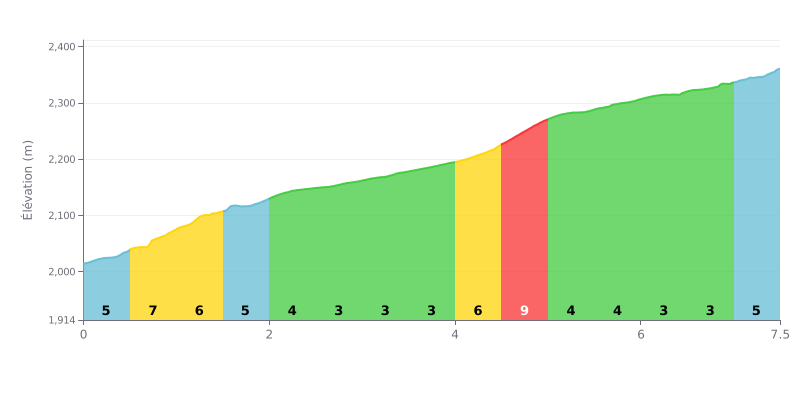
Difficulty breakdown: With 7.5 km for 348 m of elevation gain and an average gradient of 4.6%, this climb is tough without being brutal. The start is steep right away with 5% over KM 0.0-0.5, then 7% over KM 0.5-1.0, and the KM 2.5-4.0 section at 3% offers some relative respite. The key stretch comes between KM 4.0-4.5 at 7% and KM 4.5-5.0 at 9%, the steepest point on the course, before a final 5% over KM 7.0-7.5.
Tips for managing your effort:
1. Pace the start. Don't get carried away in the first kilometres at 5% and 7%, or you'll arrive at the 9% ramp of KM 4.5-5.0 with nothing left in the tank.
2. Recover on the false flat. Use the KM 2.5-3.0 section at 3%, and the following 3% stretches, to spin an easy cadence and get your breath back.
3. Tackle the wall the right way. On the 9% KM 4.5-5.0 section, stay seated, keep a high cadence in an easy gear, then ease off gradually over KM 5.0-5.5 at 4%.
Cyclists who have climbed Teide agree on one thing: it's a climb you have to earn. The gradient is constant, often between 7 and 8%, over a very long distance, which makes it a first-class physical and mental challenge. The difficulty lies less in extremely steep sections than in this demanding consistency that wears down your legs and your head over time.
What stays with riders, beyond the effort, is the radical transformation of the landscape. Riders describe a feeling of travelling through different eras, starting in subtropical vegetation and reaching a almost lunar scenery near the summit. The road snakes through pine forests before opening onto desolate, majestic volcanic plains, with breathtaking views over the neighbouring islands on clear days.
The experience is however tempered by traffic conditions. Several riders report a difficult coexistence with traffic, especially cars and motorbikes that can pass fast and close. The road, though generally in good shape, has stretches where the surface is rougher, and litter on the verge is sometimes mentioned, a reminder that the climb takes place in a very busy environment.
Despite these downsides, the atmosphere among riders is often described as supportive and motivating. Riders encourage each other, creating a fleeting community along the climb. Reaching the checkpoint, often in the cold and at altitude, delivers an intense sense of accomplishment, a reward worthy of the effort put in.
In the end, the accounts agree: climbing Teide is far more than just a climb. It's a complete adventure that tests your limits, offers unforgettable scenery and leaves a lasting memory, provided you're ready to face both the gradient and the reality of the road.
7.5 km • 348 m D+
VAM: average climbing speed, based on elevation gain


Join thousands of cycling fans! Plan your rides, record your performance, track your progress and discover the finest climbs.
Live climb profile to pace your effort all the way to the top.


Other climbs to Pico del Teide
Within 20 km