Mont Kilimandjaro is a climb of 12.1 kilometers (category 1). Mont Kilimandjaro tops out at 1,578 m above sea level. It is located in Kariwa, Kilimanjaro, Tanzania. The average gradient is 5.6% with a maximum of 16.7%. The climb has 672 meters of elevation gain.
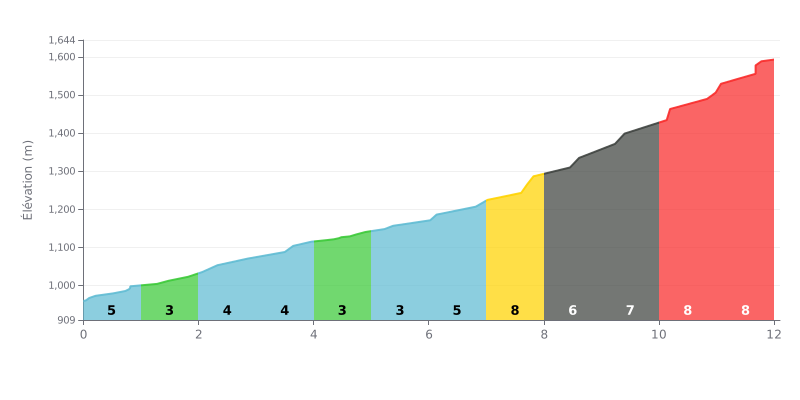
Difficulty breakdown: This Category 1 climb has a two-part profile. The first 6 km are moderate (3-4%), giving you time to find your rhythm. The gradient ramps up significantly in the second half, with a tough sequence of 6%, 8%, 7% and a kilometre at 10% between KM 10 and KM 11, which is the crux of the climb.
How to manage your effort:
1. Pacing the first half: Use the first 6 km, which are less steep, to settle into a steady effort (below threshold) without burning matches too early.
2. Prepare for the final ramps: Save something for the last 4 km, especially the 10% section. Spin a high cadence to keep control on the steep gradient.
3. Break the climb down mentally: Think of the ascent in three sections: the approach (KM 0-6), the hard core (KM 6-10), and the final test (KM 10-12). This helps you stay focused.
According to cyclists who have climbed Kilimanjaro, the ascent is an extraordinary adventure that leaves a lasting mark. It's not just a climb, but a journey through five different ecosystems, from lush tropical rainforest to the lunar landscapes of the alpine desert, before finally reaching the eternal snows on the roof of Africa. The variety of scenery, which changes completely every day, is consistently cited as an unforgettable highlight.
The experience is described as more of a mental challenge than a purely physical one. The key to success lies in perseverance and adapting to altitude. Riders advise going "pole pole" (slowly, slowly), staying well hydrated, and not underestimating the difficulty of the final night push, which is often brutal due to the cold, the wind and the lack of oxygen. Acclimatization is essential, and 7- to 8-day itineraries are recommended to maximize your chances of reaching the summit.
One point keeps coming up: the crucial importance of the local crew. Guides, porters and cooks are presented as the real heroes of the experience. Their professionalism, constant support, encouragement and good humor are essential for getting through the tough moments. Reaching Uhuru Peak is felt as a collective victory, a huge sense of pride shared with the whole team.
Despite the challenges, the feeling on the way back down is unanimous: it's an experience that is worth every effort. The view from the summit at sunrise, the sense of accomplishment and the breathtaking scenery leave an indelible memory. Cyclists come back transformed by the challenge, with a better understanding of themselves and the feeling of having lived through something extraordinary.
12.1 km • 672 m D+
VAM: average climbing speed, based on elevation gain


Join thousands of cycling fans! Plan your rides, record your performance, track your progress and discover the finest climbs.
Live climb profile to pace your effort all the way to the top.