Ghapul Pass is a climb of 9.7 kilometers (hors catégorie). Ghapul Pass tops out at 2,397 m above sea level. It is located in Haripurdhar, Himachal Pradesh, India. The average gradient is 12.8% with a maximum of 10.7%. The climb has 1242 meters of elevation gain.
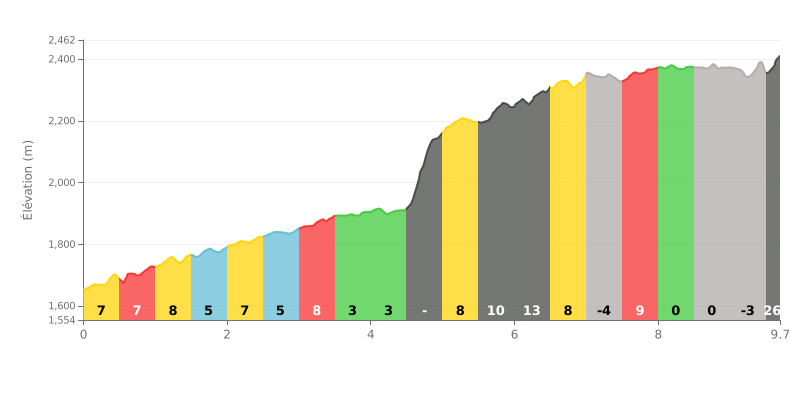
Difficulty breakdown: At 9.7 km, with 1,242 m of climbing and an average gradient of 12.8%, the Ghapul Pass is a very demanding HC climb. The first 4.5 km, between 3% and 9%, keep your legs working non-stop before the hardest section, at km 4.5-5.0 at 49%. The second half, with stretches at 11% and 13% between km 5.5 and 6.5, then a final ramp at 30% from km 9.5 to 9.7, calls for a clear-headed pacing strategy all the way to the summit.
Tips for the effort:
1. Pace the start. Stay seated over the first kilometres, with a smooth cadence and a gear suited to the 5% to 9% gradients.
2. Prepare for the 49% section. Shift down well before km 4.5 and keep a stable position so you don't blow up on that wall.
3. Use the flat section. On the km 8.0-9.0 stretch at 0%, drink, eat and get your breathing back under control before tackling the 30% ramp at the end.
By the accounts of riders who've tackled it, the Saach Pass climb is an epic, out-of-the-ordinary adventure, often described as one of the most dangerous and demanding roads in the Indian Himalaya. Riders agree on one thing: this isn't a casual spin, it's a serious expedition that leaves you with an enormous sense of accomplishment once you reach the top.
The ride is defined by an extremely tough road, a real technical challenge. Riders describe a section that is completely unpaved after Bairagarh, littered with rocks, with plenty of river crossings and slippery stretches. Black ice, even in summer, and the high altitude (above 4400 metres) bring thin air and a real risk of acute mountain sickness, which only adds to the difficulty. Get your bike dialled in, pack spares, and know how to fix a flat before you go.
In return for the effort, the scenery is described as breathtaking and pristine. Riders talk about snow walls several metres high in June and July, a string of spectacular waterfalls along the route, and a feeling of total peace thanks to the lack of crowds and no phone signal. The view from the summit, "above the clouds", is a reward you won't forget.
To enjoy the ride without stress, riders recommend setting off early in the morning and planning on the whole day for the crossing, with a very low average speed. Riding at night is strongly discouraged because of rockfall and the fact that help is hard to come by. The weather changes fast, so bring warm, waterproof layers and be ready to turn back if conditions deteriorate.
9.7 km • 1242 m D+
VAM: average climbing speed, based on elevation gain


Join thousands of cycling fans! Plan your rides, record your performance, track your progress and discover the finest climbs.
Live climb profile to pace your effort all the way to the top.