Paso de San Francisco is a climb of 16.0 kilometers (category 3). Paso de San Francisco tops out at 4,750 m above sea level. It is located in Copiapó, Región de Atacama, Chile. The average gradient is 2.6% with a maximum of 10.8%. The climb has 413 meters of elevation gain.
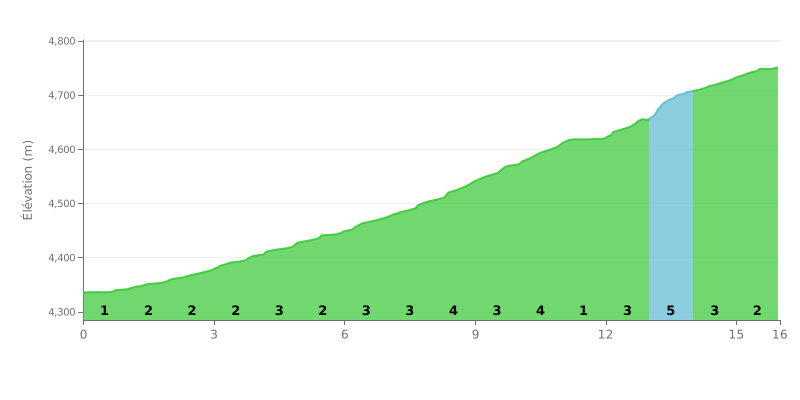
Difficulty analysis: This 3rd category climb (16 km at 2.6%) is long, but the average gradient is moderate. The difficulty lies in its irregularity: after a fairly gentle first half (gradients of 1-3%), the second part is more demanding, with stretches at 4-5% (KM 8-9, 10-11, 12-14), especially in the last 4 kilometres.
Tips for pacing yourself:
1. Managing your rhythm: Don't let the easy start fool you. Save some legs for the steeper sections from KM 8 on, especially the kilometre at 5% (KM 13-14).
2. Plan your recovery: Make the most of the kilometre at only 1% (KM 11-12) to recover before the last hard part.
3. Gearing: Choose a gear ratio suited to the short 4-5% climbs. Avoid going all-out too early so you can keep a steady power output over the whole ascent.
For cyclists who have climbed the Paso de San Francisco, the experience is one of total immersion in the immensity of the Andes. They describe a succession of jaw-dropping scenery along the legendary Ruta 60, the "Road of the Six Thousanders", where volcanoes soaring above 6,000 metres line the horizon in a dizzying skyline. Riders talk about shifting colours, arid desert, lagoons with glassy, mirror-like water, and the silent presence of vicuñas along the roadside, creating a unique atmosphere of solitude and grandeur.
According to the accounts, the main challenge isn't the state of the road. The Argentine side is described as fully paved and in excellent condition. The real issue is the extreme altitude. Riders stress the need to acclimatise and prepare properly, as the pass tops out above 4,700 metres. Altitude sickness symptoms (headaches, nausea) come up often. Their advice is to start early, drink plenty of fluids and pack warm layers, since the weather can turn fast, often with very strong wind.
Self-sufficiency is an absolute must for this ride. Riders are unanimous: there is no services, no petrol station, no shops over the nearly 200 km between Fiambalá and the pass. Bring plenty of water, food and a vehicle in perfect mechanical shape. The equipped refugios (shelters), roughly 30 km apart, are much appreciated as a safety net in case of mechanical trouble or bad weather.
A recurring point of caution in shared experiences concerns the border itself. The crossing into Chile is only open certain days of the week (often Tuesday and Friday), and the opening hours are strict. Several cyclists recount climbing all the way up only to be turned back because they arrived on the wrong day or at the wrong time, a disappointment to plan for by checking the details carefully before setting off.
Despite the challenges, the overall impression is of an unforgettable experience and highly recommended. Cyclists speak of a sense of humility in the face of nature, raw beauty, and a road so majestic that every effort is rewarded by the surrounding scenery. For them, the Paso de San Francisco is much more than just a mountain pass; it's a moment that leaves a lasting mark.
16.0 km • 413 m D+
VAM: average climbing speed, based on elevation gain


Join thousands of cycling fans! Plan your rides, record your performance, track your progress and discover the finest climbs.
Live climb profile to pace your effort all the way to the top.