Gurudogmar Lake is a climb of 128.9 kilometers (hors catégorie). Gurudogmar Lake tops out at 5,142 m above sea level. It is located in Bringbong, Sikkim, India. The average gradient is 6.9% with a maximum of 13.9%. The climb has 8937 meters of elevation gain.
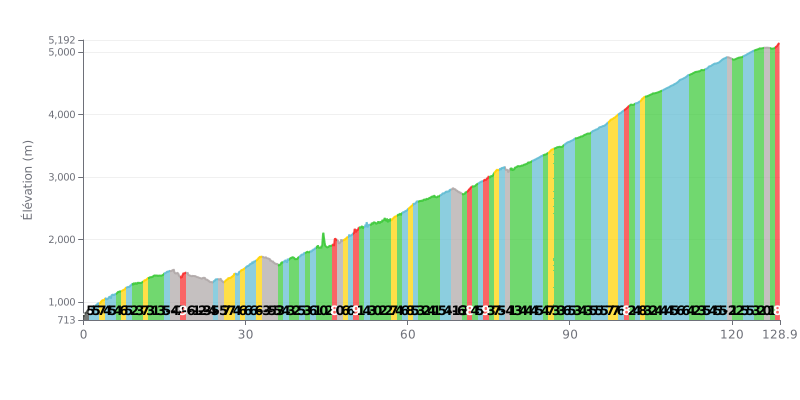
Difficulty breakdown: With 8937m of climbing over 128.9km (average gradient 7%), this ascent is extremely demanding, comparable to three or four HC climbs stacked together. The difficulty lies in its length and in the repeated steep sections (more than 20 segments at 7% or above), broken up by short descents that disrupt your rhythm without giving any real recovery.
Pacing tips:
1. Pacing yourself: Settle into a steady, controlled rhythm from the start. The opening kilometres at 11% and 6% are no excuse to go out too hard.
2. Making the most of the flats: Use the short flat sections (such as at KM 9.0, 13.0 or 47.0) to recover by spinning an easy gear without forcing, but keep a minimal effort on the slight descents so you don't lose time.
3. Preparing for the hard sections: Identify the clusters of steep pitches (e.g. KM 97.0-103.0 with four segments at 7-8%) and ease off your pace beforehand so you reach them fresher.
Cyclists who have climbed the roads to Gurudongmar Lake describe an exceptional sensory and physical experience. The climb, long and demanding on roads that are often rough and bumpy, is rewarded with breathtaking scenery, comparable to the desert expanses of Ladakh. The feeling of rising toward the peaks, surrounded by bare mountains and huge valleys, is an adventure in itself.
Reaching the lake, perched at over 5,000 meters of elevation, is a moment of pure emotion. Riders agree on the almost unreal beauty of the place: a body of water with blue reflections or partially frozen, framed by snow-capped summits, in a silence broken only by the wind. But the payoff comes at a cost: the thin air makes every pedal stroke hard work and forces you to head back down after a short while, even for the most seasoned riders.
This ride comes with practical challenges. Riders stress the need to prepare properly: very warm clothing, even in summer, and pacing yourself to avoid altitude sickness. It's crucial not to underestimate the breathing difficulty and to follow local advice, such as spinning slowly and avoiding anything that might trigger a sudden gasp for air.
Beyond the sporting challenge, riders describe a feeling of serenity and spiritual connection. The unspoiled nature, the lake's sacred status for local communities and the vastness of the landscape create a unique atmosphere, turning the climb into far more than just a cycling performance. It's a humbling, unforgettable experience, often described as the "trip of a lifetime".
128.9 km • 8937 m D+
VAM: average climbing speed, based on elevation gain


Join thousands of cycling fans! Plan your rides, record your performance, track your progress and discover the finest climbs.
Live climb profile to pace your effort all the way to the top.